
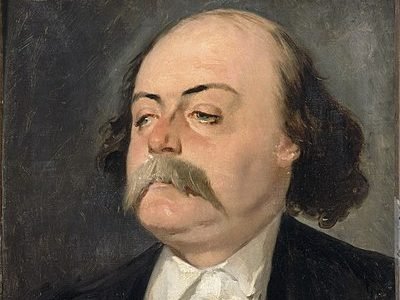
Madame Bovary Gustave Flaubert, 1857. Transl. by Eleanor Marx-Aveling.
The narrating agent, who is a character in a fictional world, is influenced by its values. Their comments and argumentative discourses can be useful in prompting the receiving agent to question whether or not they adhere to their ideas, mentality, subjectivity.
Flaubert’s novel begins with the account of a narrating agent who is among the children in the class. This character does not appear in the action, but his descriptions communicate to us information on the world of the school, its rules, its uses, and especially the values to which the young witness seems to attribute a vital importance…
We were in class when the head-master came in, followed by a “new fellow,” not wearing the school uniform, and a school servant carrying a large desk. Those who had been asleep woke up, and every one rose as if just surprised at his work.
The head-master made a sign to us to sit down. Then, turning to the class-master, he said to him in a low voice—
“Monsieur Roger, here is a pupil whom I recommend to your care; he’ll be in the second. If his work and conduct are satisfactory, he will go into one of the upper classes, as becomes his age.”
The “new fellow,” standing in the corner behind the door so that he could hardly be seen, was a country lad of about fifteen, and taller than any of us. His hair was cut square on his forehead like a village chorister’s; he looked reliable, but very ill at ease. Although he was not broad-shouldered, his short school jacket of green cloth with black buttons must have been tight about the arm-holes, and showed at the opening of the cuffs red wrists accustomed to being bare. His legs, in blue stockings, looked out from beneath yellow trousers, drawn tight by braces, He wore stout, ill-cleaned, hob-nailed boots.
We began repeating the lesson. He listened with all his ears, as attentive as if at a sermon, not daring even to cross his legs or lean on his elbow; and when at two o’clock the bell rang, the master was obliged to tell him to fall into line with the rest of us.
When we came back to work, we were in the habit of throwing our caps on the ground so as to have our hands more free; we used from the door to toss them under the form, so that they hit against the wall and made a lot of dust: it was “the thing.”
But, whether he had not noticed the trick, or did not dare to attempt it, the “new fellow,” was still holding his cap on his knees even after prayers were over. It was one of those head-gears of composite order, in which we can find traces of the bearskin, shako, billycock hat, sealskin cap, and cotton night-cap; one of those poor things, in fine, whose dumb ugliness has depths of expression, like an imbecile’s face. Oval, stiffened with whalebone, it began with three round knobs; then came in succession lozenges of velvet and rabbit-skin separated by a red band; after that a sort of bag that ended in a cardboard polygon covered with complicated braiding, from which hung, at the end of a long thin cord, small twisted gold threads in the manner of a tassel. The cap was new; its peak shone.“Rise,” said the master.
He stood up; his cap fell. The whole class began to laugh. He stooped to pick it up. A neighbor knocked it down again with his elbow; he picked it up once more.
“Get rid of your helmet,” said the master, who was a bit of a wag.
There was a burst of laughter from the boys, which so thoroughly put the poor lad out of countenance that he did not know whether to keep his cap in his hand, leave it on the ground, or put it on his head. He sat down again and placed it on his knee.
The young narrator seems to compare the newcomer from the countryside with the other children of the city’s petty bourgeoisie and methodically points out everything that is different about him. He uses adjectives that suggest that he finds him ridiculous (“dressed like a bourgeois”, “like a village singer”, “poor”, “ugly”, “imbecile”.)
The value at stake is that of social conformity, embodied by the critical and condescending gaze of the group towards those who do not fit into the mold. The stake is social status, the risk, ostracism.
This value will be central in the rest of the novel. Emma Bovary seeks a certain place in society while dreading the judgment of others. It is the fear of what people will say that destroys her, not her romantic-sentimentalist fantasies.
The narrating agent is on the side of the intolerant, normative, stigmatizing oppressor. This can/should provoke a reflection in the receiving agent and a positioning also in relation to the main protagonist of the plot.
Is Emma Bovary a victim of society?
Does she bear full responsibility for her mal de vivre?
Should I pity her? Or should I laugh at her?
Another question is that of the “implicit author’s” point of view… What does the receiving agent think about the mockery of the narrating agent in this sequence?
“Flaubertian irony” is a cliché concept that actively circulates in literary studies. Flaubert is said to take a distant and disenchanted look at the world, that he ridicules the naivety of the peasants and the pathetic ambitions of the “locals”, that he is a master in the art of sarcastic comparisons and that he mocks the “mediocrity” of Monsieur Bovary…
Flaubert (the man) confessed to “suffering” from a grating pessimism since his early childhood, and his contemporaries noted his marked penchant for disillusioned bitterness in their correspondence, but these are not sufficient reasons to assert that the narrating agent of Madame Bovary IS Flaubert.
The question of the tone of the novel’s point of view is open to interpretation, even though the narrator of the first scene is soon transformed into an “extradiegetic”, anonymous and omniscient narrating agent whose status is (could be) close to Flaubert’s convictions on the matter:
The author in his work must be like God in the universe, present everywhere and visible nowhere.
(Letter to Louise Colet, December 9, 1852.
God may be invisible, his glance does not weigh less on the destiny of the individuals.
