
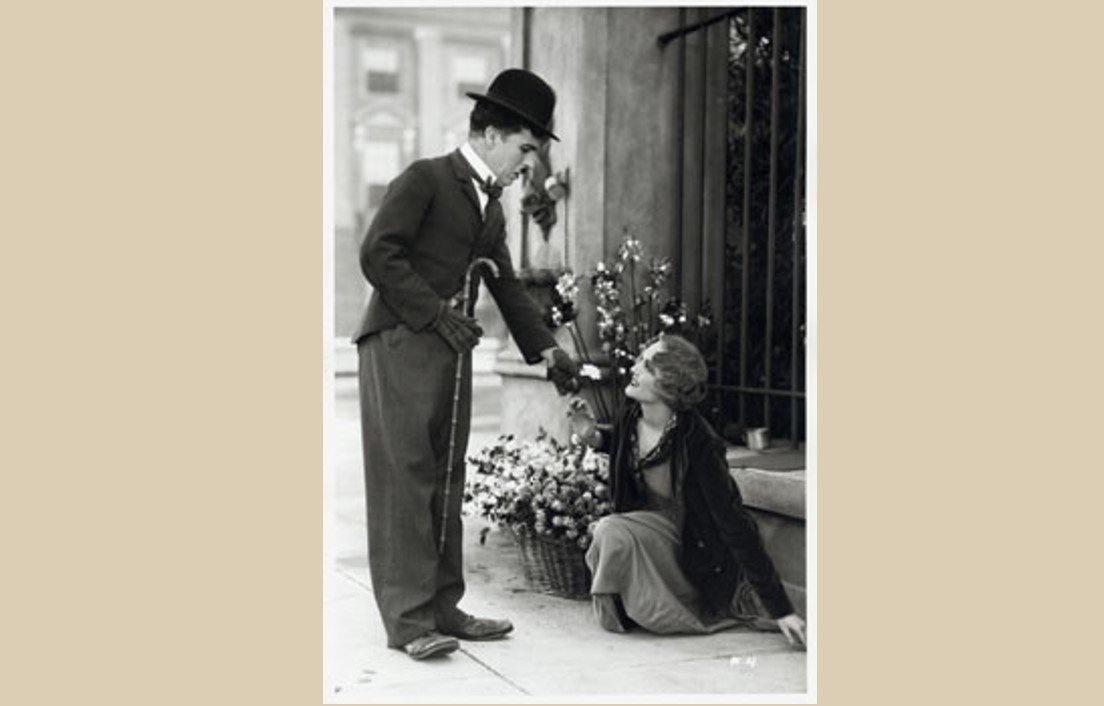
City Lights, Charlie Chaplin, 1931
The dominant traits of secondary characters are sometimes chosen based on the obstacles they can potentially represent for the protagonist (cohesion factor).
In 1928, Charlie Chaplin wrote a new screenplay based on an idea he had during the production of his film The Circus: a clown tries to hide from his child that he is going blind…
For Chaplin, the theme of blindness is in line with the identity of his protagonist, the little vagabond with the manners of a gentleman.
“The Tramp” is a homeless man that nobody wants to see. Or when he does attract attention it is for the wrong reason. The others do not see him as a human being, but as a parasite. His humanity is denied. Alone in the big city, he resolves to admire the statue of a naked woman in a shop window.
The plot of the film revolves around The Tramp’s relationship with a rich man who is depressed by his wife’s departure. Grateful to have prevented him from committing suicide, the man declares him a “friend for life” and takes him out to party. The problem is that the next day he has forgotten everything and no longer recognizes the Tramp (a form of “blindness”) …
Like any self-respecting romantic melodrama, the narrative requires a love plot.
Let’s imagine being in the place of a narrating agent who must now find the character with whom The Tramp will fall in love.
The proposed method is to apply different types of cohesion factors to the characterization of the central protagonist and to select the association that generates the most relevant meaning and/or emotions.
The starting point is the main feature of the protagonist. In order to know which will shed interesting light on the ostracism he is subject to and his loneliness, different types of cohesion should be tested:
/Confirmation: The Tramp meets a broad-minded companion who has no problem with his poverty and outsider status (“Nobody’s Perfect” Some Like it Hot, Billy Wilder, 1959).
/Contradiction: The Tramp meets a rich companion (this is the stereotype of the “odd couple”, King Kong, M.C. Cooper, E. B. Schoedsack, 1933; Harold and Maud, H. Ashby, 1971)
/Metaphor: A ghost (they are also invisible…)
/Concordance : Another homeless companion or victim of society’s rejection.
/Inevitability: A child (The Kid). One is born poor, and one remains poor…
/Confirmation: A character who profits from his status of helpless victim (as is the case in the arranged boxing match scene).
Un personnage qui prend parti de son statut de victime impuissante (c’est le cas dans la scène du match de boxe arrangé).
/Contradiction: Nobody sees him. Society is blind. Society has decided not to see him. The Tramp could meet someone who can’t see him, a blind person…
This last association is appealing, because it accentuates the desperation of the character of The Tramp and makes us think about social injustice: the only person who shows interest in him does not see him. He remains physically invisible to the other person, so their humanity will have to link them on another level.
This necessity underlies the relationship between the vagabond-false-rich and the little flower seller until the last scene in which Charlot, in total destitution, finally lets her “see” his true identity.
“You can see me now.”
