
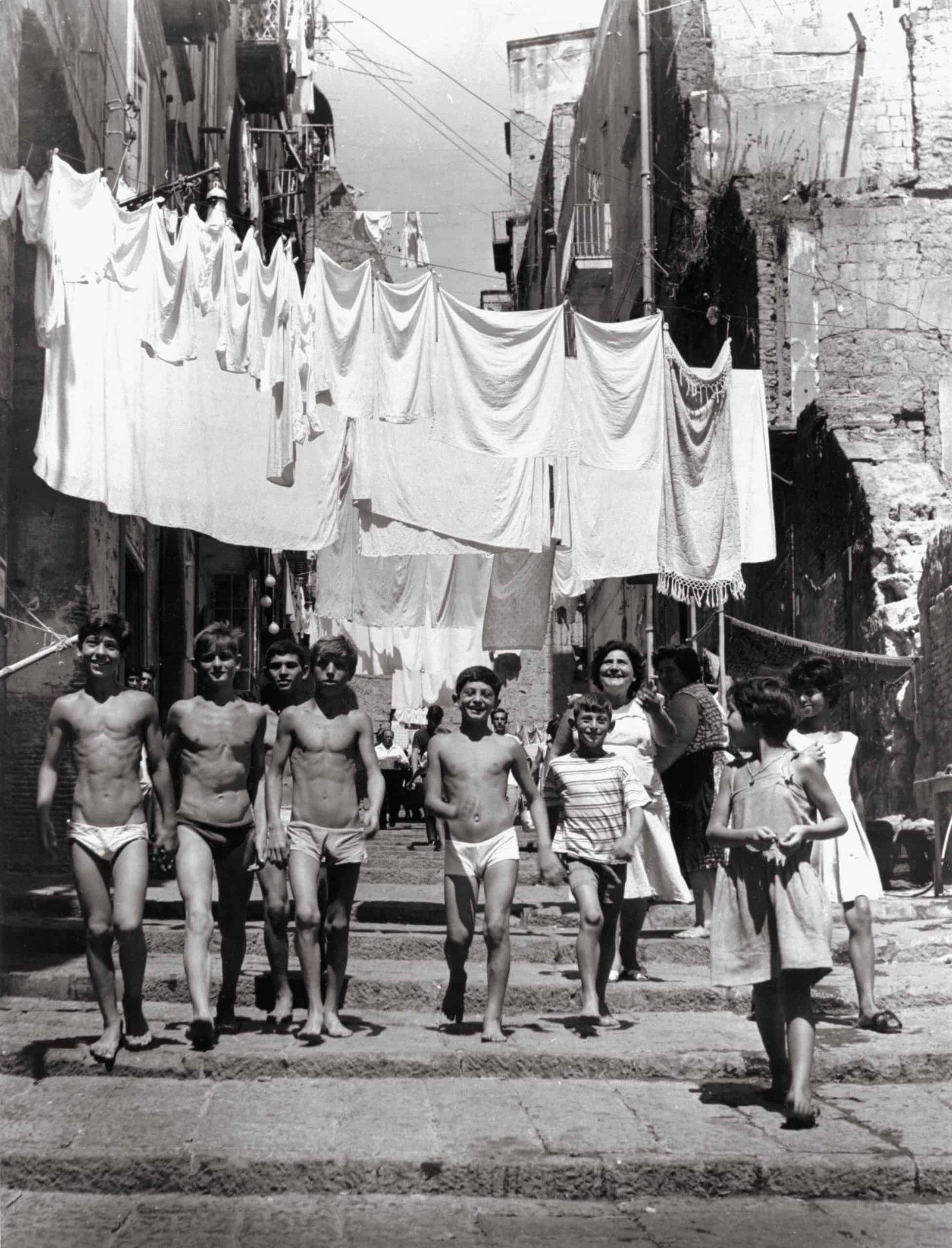
Mario Cattaneo From the series Alleys in Naples, Naples, 1951-58
© Museo di Fotografia Contemporanea, Milano-Cinisello Balsamo
L’amica geniale (My Brillant Friend), Elena Ferrante, transl. Ann Goldstein, 2011
The stakes and risks associated with the characters’ environment are potentially the source of surprises rich in insight.
The first book of the Neapolitan Novels series is about the childhood and adolescence of two protagonists who live in a poor and violent suburb of Naples: Elena (‘Lenù’) Greco and Raffaella (‘Lila’) Cerullo.
Elena, both dazzled and intimidated by Lila, does everything she can to gain her approval and to live up to her standards.
Although her parents don’t think their daughter can continue her studies beyond primary school, Elena does well and is able to enter secondary school. Lila, a child prodigy who taught herself to read and write, begins working in the family’s shoe repair shop.
Lila says she wants to continue studying Latin, but repairing shoes takes up all her time and the two friends lose touch.
The extract chosen is chapter eight of part two: “Adolescence – The Story of the Shoes”.
After a disappointing first year of high school, Elena flunks out. Lila, who has learned the basics of Latin on her own, helps her to revise during the summer holidays. She is a strict and demanding tutor. When it’s time for Elena to go back to school, Lila promises to continue studying while working at the shoe repair shop.
School began again and right away I did well in all the subjects. I couldn’t wait for Lila to ask me to help her in Latin or anything else, and so, I think, I studied not so much for school as for her. I became first in the class; even in elementary school I hadn’t done so well.
Elena seems intrigued by the fact that her progress at school is not motivated by her desire to succeed, but by her desire to please her friend.
… and so, I think, I studied not so much for school as for her.
The narrating agent analyses the meaning of the situation (her emotion) and thus introduces the material for this new chapter. It will be about the power that others can have over you, and more generally about the power of society and the social status of individuals.
Another event adds to the impression that she is not/no longer in control of herself:
That year it seemed to me that I expanded like pizza dough. I became fuller in the chest, the thighs, the rear.
This contingent event (the onset of puberty) becomes a narrative knot linked to the previous one by the cohesion factor: once again something happens that Elena feels she has not really chosen.
The following event is interpersonal. The narrating agent has chosen to narrate it now to illustrate the idea of loss of control that has occupied her since the beginning of this chapter. Note the absence of a full stop between the first narrative knot and the narration of the next event:
I became fuller in the chest, the thighs, the rear. One Sunday when I was going to the gardens, where I was planning to meet Gigliola Spagnuolo, the Solara brothers approached me in the 1100. Marcello, the older, was at the wheel, Michele, the younger, was sitting next to him. They were both handsome, with glossy black hair, white teeth. But of the two I liked Marcello better; he resembled Hector as he was depicted in the school copy of the Iliad. They followed me the whole way, I on the sidewalk and they next to me, in the 1100.
The typographical proximity of the two narrative knot reinforces the causal value that the narrating agent wants to give to the second: the boys approach her because her body has changed.
Will she be able to give free rein to her desire?
[…] When do you get the chance to ride in a car like this?
Never, I thought. But meanwhile I said no and kept saying no all the way to the gardens…
That day, Elena said no in spite of herself.
They were both handsome, with glossy black hair, white teeth.
This intrapersonal event (the obstacle is a value of the world of the plot that she has integrated: boys desire girls) is associated with the stakes-risks factor in the narrative to, once again, illustrate the notion of lack of real choice.
I said no because if my father found out that I had gone in the car, even though he was a good and loving man, even though he loved me very much, he would have beat me to death, while at the same time my little brother, Peppe and Gianny, young as they were, would feel obliged, now and in the future, to try to kill the Solara brothers. There were no written rules, everyone knew that was how it was.
In this descriptive and argumentative discourse (That was how it was) the narrating agent portrays the patriarchal world in which she lives.
She then decides to illustrate the stakes-risks involved with another example in the form of an embedded narrative. She narrates what happened when her friend Ada was forcibly pushed into the car by the Solara brothers, the chain of violent reprisals and counter-reprisals involving Ada’s brother, the Solara brothers’ father and even the employees of their business.
This incident adds to the reflection on the concept of individual freedom. Is it ultimately enviable to be free from the macho and potentially phallocratic gaze of boys?
