
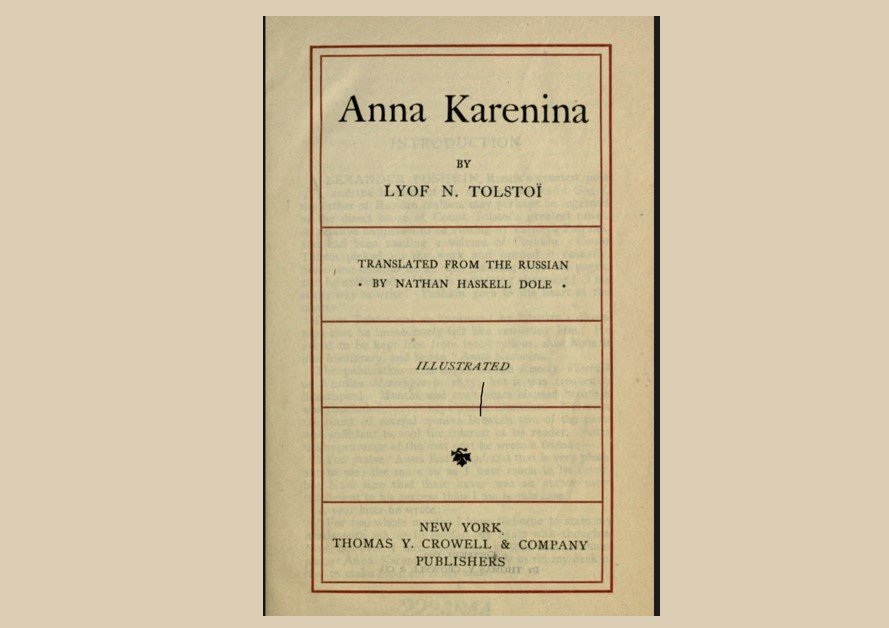
Anna Karenina, Tolstoy (Leo), 1878
Multidimensional characters may have inner dimensions that are at odds (cohesion/contradiction factor) with those that motivate them in their public life (explicit objectives and strategy).
In Moscow train station, two young people fall in love at first sight (intrapersonal event). The wife of a high-ranking civil servant, a prominent member of the Tsarist high society, Anna Karenina dazzles (interpersonal event) the frivolous Count Wronsky with her grace, elegance and gaiety. They find it difficult to resist the temptation of initiating a passionate affair.
This short synopsis summarizes one of the three plots of Tolstoy’s novel, the one in which Anna is the main protagonist. It gives the impression that its protagonist is pursuing only one objective: an adulterous relationship with a sexy young officer…
Only a story will be able to elevate this banal plot to the level of an epic tale and give its protagonist the status of a multidimensional character.
The Story that Creates the Plot
To get to the story we have to go back to the event without which none of the events of the plot would take place: the initial story event.
One method is to ask the question “why?” and keep asking it until it loses its relevance or becomes purely esoteric, or – this is the step we are interested in – stops at the answer: because it is the essence of the character.
Let’s start with the first appearance of Anna Karenina, on the train from St. Petersburg.
Why is she on this train?
She is coming to visit her brother Stiva Oblonsky.
What is the purpose of her visit?
Anna wants to help her brother to solve a crisis in his marriage. Stiva has sinned with the housekeeper and Dolly threatens to leave with their seven children…
But why does Anna get involved in this matter?
Anna Arkadyevna Karenina lives in St. Petersburg. She is trying hard to keep up with her position as a young woman of the Russian nobility (objective). She is elegant, intelligent, educated, kind, creative, generous, pious (action/strategy). Her husband, Alexei Karenin is a state official. They have a son, Sergei, eight years old… She hopes to live in peace with her conscience (expected result).
► Antagonist obstacle: One day, a letter from Stiva arrives, confessing his act of weakness, his sin…
► Surprise: Anna is upset. Her daily life is turned upside down. She is no longer at peace with herself (intrapersonal obstacle).
► Suspense: What should she do?
► The investigation: In Anna’s eyes, all this can only be a horrible misunderstanding. Her analytical skills (the investigation) do not allow her at this stage to reflect on the meaning of her own reaction of surprise and error (Two errors in fact: that of believing that she can ignore her true nature (and live in peace with her conscience), and that of believing that her brother could also escape the family “curse” – Aristotle’s Hamartia?)
But the narrating agent knows this and we, receiving agents, will understand it in retrospect, when later in the timeline the plot reveals aspects of Anna’s personality and love – and presumably sexual – frustrations.
► Reaction (new objective/action): She decides to rush to Moscow.
The Initial Story Event and the Protagonist’s Inner World
The event caused by the arrival of Stiva’s letter is the initial story event of the plot narrated in the novel for two reasons:
1. Without the arrival of this letter, Anna would not have gone to Moscow, she would not have met Wronsky at the station. None of the events narrated later would have taken place.
2. The surprise provoked by the letter reveals the intrinsic conflict in Anna’s consciousness, the torment that defines her: Anna is a young woman who longs for something else. This implicit objective and Anna’s inner turmoil constitute the additional dimensions of her character.
Stiva’s letter and Anna’s surprise move us. As soon as we learn the purpose of her journey, we are favorably disposed towards this young woman who leaves her husband and child to rush to the rescue of her brother’s marriage. Her devotion, her compassion, her generosity make us like her.
For some, this capital of sympathy is put to the test upon arrival at the Moscow station when Anna, a married woman, is troubled by the sight of the young officer Wronsky.
As we will understand later, Anna Karenina is tormented by the inner demands of absolute, ideal and sensual outbursts.
Everything is the opposite of the image she gives of herself on her arrival, everything is the opposite of what her husband Alexei can offer her, a disenchanted, distant, conventional man… with “long ears”.
But her religious upbringing, her social conformity and her lack of confidence fight against what she considers a “curse”.
When Anna learns of her brother’s extramarital affairs, she is surprised. But deep down she probably isn’t that surprised. She and Stiva share the same blood, the same “dark side”. Her brother’s act frightens her as much as it piques her curiosity.
Until now, Anna has succeeded in spreading the image of a virtuous and conformist young aristocrat. She has also found substitutes for the lack of love in her marriage, such as the fusional relationship she has with her son, the most important person in her life, she says. But always her dissatisfaction and the temptations of her senses pursue her, and she is unable (or unwilling) to deny them completely.
An Epic Dimension
Anna Karenina is the typical tragic heroine: not completely guilty, not completely innocent.
At first, Stiva’s relationship with his wife Dolly provides Anna with proof that a proper family is possible in spite of everything. It is possible to defeat the “monster” that haunts them both!
But now this lifeline seems illusory. There are cracks appearing in Anna’s incantatory picture that she hastens to try to seal.
She rushes to Moscow wanting to believe/to make believe that she is doing it for her brother (explicit objective). But in fact, this decision is only a strategy, conscious or not, to “investigate” her own torment, her temptations, her frustrations, her guilt (implicit objective).
It is also a way to escape from one’s own reality. Instead of questioning her personal choices (her husband for example), trying to correct what does not suit her (a divorce) she opts for the perpetuation of fantasies and lies (the social conformist Stiva regrets what he did).
This reality-illusion dichotomy (cohesion/contradiction) makes Anna a multidimensional character, it is also the DNA of Tolstoy’s novel. It inspired the author in his choice of disturbing factors in the plot of which Anna is the protagonist. She dreams of a torrid love affair? Then let’s confront her with a fantasy that becomes reality, etc.
It is interesting to note how the same type of tension underlies the events of the other two plots of the novel.
