
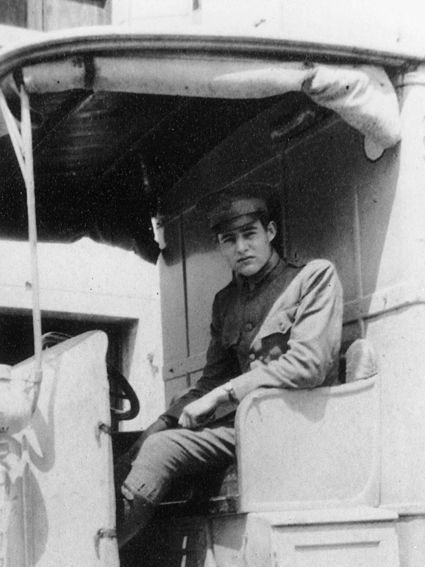
A Farewell to Arms, Ernest Hemingway, 1929.
Applying the distance factor to descriptive elements can constitute a form of commentary on the described world and situation(s)
The homodiegetic narrating agent of Hemingway’s novel narrates his trip back to the front and describes the landscape he is looking at from the window of his car.
Descriptive elements of his narrative are underlined below:
Now in the fall the trees were all bare and the roads were muddy. I rode to Gorizia from Udine on a camion. We passed other camions on the road and I looked at the country. The mulberry trees were bare and the fields were brown. There were wet dead leaves on the road from the rows of bare trees and men were working on the road, tamping stone in the ruts from piles of crushed stone along the side of the road between the trees. We saw the town with a mist over it that cut off the mountains. We crossed the river and I saw that it was running high. It had been raining in the mountains. We came into the town past the factories and then the houses and villas and I saw that many more houses had been hit, On a narrow street we passed a British Red Cross ambulance. The driver wore a cap and his face was thin and very tanned. I did not know him.
In Farewell to Arms, private Hemingway returns to the front after a leave of absence following a gun wound. He travels by train and then by truck. He focuses his attention on nature, which persists in keeping to its agenda despite the surrounding chaos (Now in the fall…), the roads are repaired while the war destroys houses, the protagonist says he doesn’t know the ambulance driver. He is alone.
These are not mere decorative vignettes that pass before our eyes, but a selection of images influenced by the point of view of the narrating agent. The stylistic simplicity of the description, the almost banality of what is described, the almost telegraphic style, as if distanced from the reality of war, could be understood as an implicit expression of the narrating agent’s opinion on the absurdity and inanity of war.
