
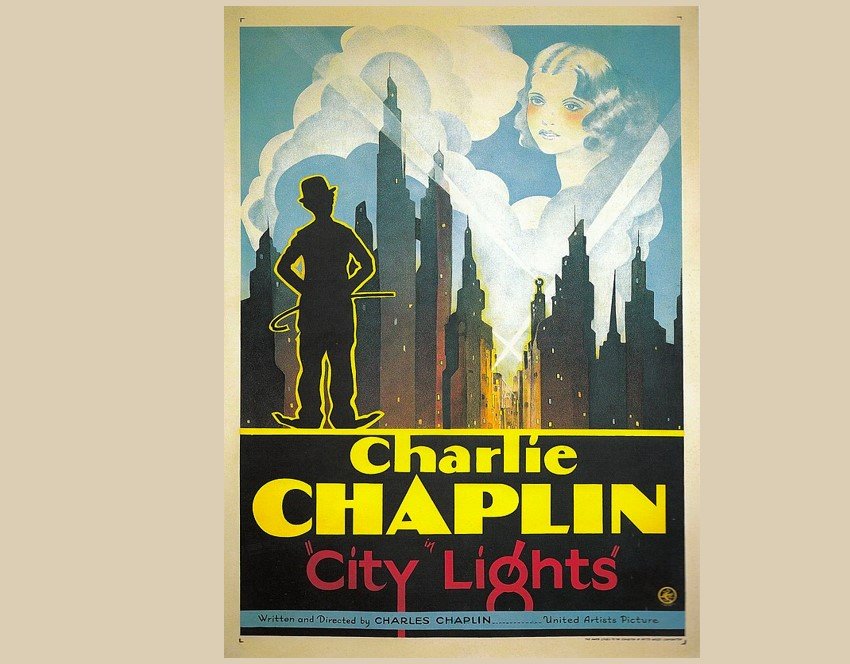
City Lights, Charlie Chaplin, United Artists, 1931
Each obstacle in the events that precede and follow a particular situation can be linked by the cohesion factor.
In 1928, Charlie Chaplin began developing a new screenplay based on an idea he said he had had during the production of his hit film The Circus: a clown tries to hide from his child that he is going blind…
The theme of blindness seems to have informed the creation of the plotting of City Lights. In retrospect, this choice was logical for Chaplin, as it was in line with the identity of his iconic on-screen character.
The “Little Tramp” is a homeless man rejected by society. People do not see him as a human being, but as a parasite. His humanity is denied. Society has decided not to “see” him. Society is blind. Having him meet a character who cannot see is an ironic coincidence that reinforces his despair.
So, the Tramp Will Fall in Love with a Young Blind Woman…
The first event that comes to mind is the discovery of the blindness of this character by the protagonist of the plot.

This contingent obstacle (blindness) is an opportunity for the protagonist and the receiving agent to meditate on the cruelty of fate. The only person who shows interest in Charlie does not see him, as does the society that rejects him…
Imagine being in the place of a narrating agent who starts the creation of the plot and the narrative with this idea: the protagonist discovers that a young woman he fancies is blind.
We suggest now to explore the application of different types of cohesion factor to imagine the circumstances of their chance meeting and the events that lead to the discovery of blindness, and those that follow it:
/Causality. The first factor allows us to address the question of the circumstances of the encounter of The Tramp and the Young Blind Woman. Who has the best excuse to start a conversation? Charlie, rather shy, is not used to approaching women in the street (we see him coyly ogling at a nude statue in a window display). So, it has to be her, mainly because she doesn’t see who she’s dealing with.
/Contradiction. Why does she approach him? She believes he’s rich, which is the opposite of a trait of his “characterization” (being poor).
/Causality. Why is it important to her that he is rich? Because she wants to sell him something (she wouldn’t have wanted to if she had seen who he was). Selling flowers on the street is a plausible occupation for a poor blind young woman (“characterization”) …

/Causality. Why does she think he is rich? Because she knows her clients are rich and she thinks that he is one of them.
/Causality. Why does she believe that Charlie is one of her rich clients? It can only be because she hears something. This sound must be related to the activity of her customers. Are they coming out of a department store? A theatre? A restaurant? None of these places are familiar to the Little Tramp character.
/Causality. So why is Charlie here? We could accept that his presence is due to chance (he has nothing else to do but wander around the city), but we could also raise the bar and find a cohesive connection with the situation: the presence of a flower-girl on a sidewalk, where there are wealthy people: Her customers get out of their cars and slam the doors (the sound).

/Causality. Why would Charlie get out of one of these cars? To find a reason, let’s apply the cohesion factor to this situation:
/Contradiction. Charlie is not using a car to get around, but as a mere passing route. It is not the car that is moving, it is him…
/Causality. Why does he have to use this route? Because he has no choice but to escape from something or someone…


Charlie meets the flower-girl. She calls him to offer him a flower.
/Causality. How does The Tramp act when the flower-girl calls out to him (suspense)? He is surprised (how could she believe that he would buy flower, a penniless vagabond?!) and confused (maybe she is interested in him?)

For a moment, the protagonist believes that he is experiencing an interpersonal event: he approaches, chooses a flower, lets the girl approach his face and touch his collar, picks up the fallen flower… until he realizes that she is blind and understands that he is in the midst of a contingent event (the initial plot idea). What he believed to be “interest” was is in fact a misunderstanding due to her blindness (“insight”: cruel irony)
The information is confirmed when she hears a customer slam the door of his car.

The young woman, who wants to give him change, thinks he has gone. Charlie has become a non-person again…
Suspense: what will he do?
Confused, he tiptoes away.

Before reappearing a moment later.
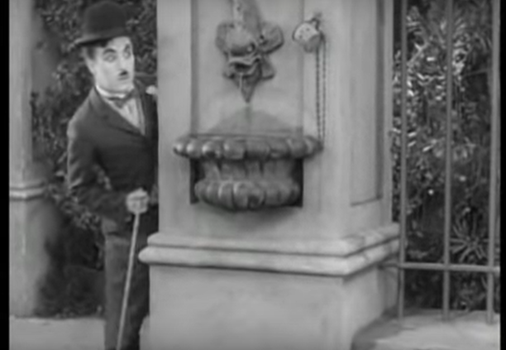
What happened “off camera”?
An intrapersonal event linked to the plot initial narrative knot (a young blind woman) by the application of the cohesion/concordance factor: What does the young woman’s blindness mean to Charlie? A way to look at her without her noticing…
He realizes this opportunity, turns around, settles down, stares at her… and undergoes another application of the cohesion factor to the blindness of his lover, this time it is inevitability: When you are blind, you can’t see…

