
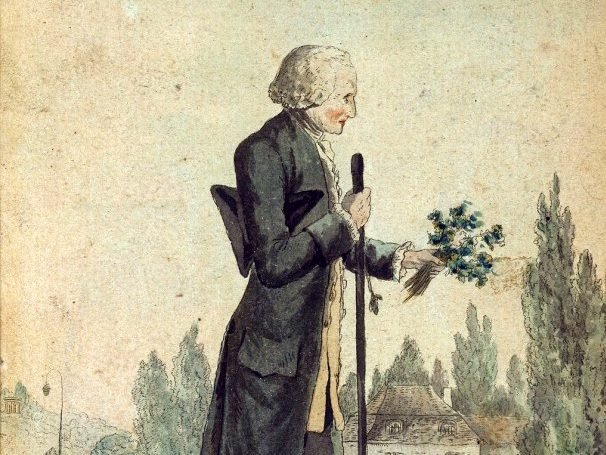
Reveries of the solitary Walker, Jean-Jacques ROUSSEAU, 1778.
Emotion is created by applying the cohesion factor to the descriptive discourse tool. The landscape described is analogous to the state of mind of the describing agent.
The “implicit author” Jean-Jacques Rousseau is the “homodiegetic” describing agent of this autobiographical text written in the first person.
This extract first situates the scene in time:
… the peasants too, having completed their autumnal labour, had retired till the return of Winter should furnish them with fresh employment; the country was yet green and pleasant, though the trees, partly stripped of their leaves, presented the picture of solitude, and indicated the approach of a more dreary season. From these various objects, resulted a mingled impression of melancholy and pleasure…
The rest of the sentence is a personal comment:
... too analogous to my age and fate, not to enforce the application. I contemplated within myself the decline of an innocent, though unhappy life, my soul still full of lively feelings, and my mind yet graced with some remaining lustre, though already faded with grief, and dried up by sorrow. Lonely and forsaken, I felt the forward frost steal on me;
By comparing his own situation to the landscape, the describing agent applies the cohesion factor to his description, which takes on the value of metaphor (analogy).
A connection is created between the description and the commentary that follows. In this way, the describing agent can share his intimate emotions with us.
By daring to compare himself to the “terminal” landscape, the solitary walker puts his life into perspective. The landscape takes on a symbolic function (the end of a life) and the emotions it induces touch us.
To compare oneself to an autumn landscape announcing winter is to acknowledge one’s finitude and the anguish it provokes.
The describing agent confesses his regrets, his melancholy, and his solitude. It is the sincerity of an old man who is not certain of seeing the next spring, nor perhaps of wanting to, that implicates us as human beings.
The landscape thinks itself in me and I am its consciousness (Paul Cezanne)
