
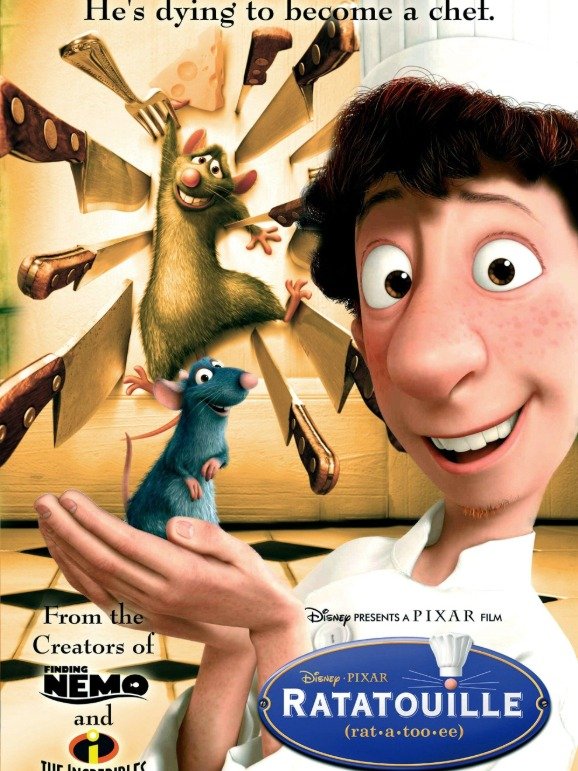
Ratatouille, written by LEWIS (Brad) from an original story by PINKAVA (Jan), CAPOBIANCO (Jim), directed by BIRD (Brad), Walt Disney Picture, 2007
Animated films and comic strips are laboratories for the treatment of believability. They allow us to push the limits of reality and the truths that a narrating agent believes they can deduce.
On this site, the entity producing a narrative (the narrating agent) applies narrative factors to narrative tools (e.g. a world) with the aim of fulfilling narrative functions (adhesion, cognition, emotions).
In Ratatouille, the plausibility factor is brought into play to move and challenge us by depicting the fate of two unusual protagonists in their respective worlds.
1. A Realistic Plot
The film’s plot is set in a world fundamentally similar to the one we know: a corner of the French countryside, Paris in the 50s and 60s, and sewers such as we can visit today in the French capital.
Realism is reinforced by a large number of specific details that bear witness to the meticulous research carried out by the authors (e.g. the burn marks on the cooks’ arms).
The elements that make up the world of the plot may not play a role in the plot (in which case they belong to the descriptive “discourse” of the work), or on the contrary contribute to its events. In the film, this is the case, for example, with car traffic in the streets of Paris, an obstacle with which the protagonists are directly confronted on several occasions.

In accordance with the terminology used on this site, the addition of significant details is an application of the realism factor.
The plausibility factor, on the other hand, is not applied to the plot, as the narrating agent has not pushed the limits of what’s true in this real world, and no supernatural elements have been added.
This factor is, however, applied to the narrative.
2. A Real Plot World Seen Through the Prism of the Narrating Agents
The “supernatural” element of the narrative is the fact that it is shown in the form of animated drawings, or computer-generated images.
Graphic representation adapts the reality of the described world to the artist’s vision, without ever making it “unreal”. The limits of what’s true are pushed back, but the world of intrigue remains plausible. The adhesion pact is respected.
In this way, the realistic Paris of the 50s and 60s is transformed into a picturesque, colorful, exotic vision, with some surprisingly unusual or even anachronistic details:
– Streets filled exclusively with 2CVs or Citroën DS vans.
– These typical sixties vehicles are complemented by more modern ones.
– Props go from old sixties television sets to DNA tests.
– Some of the characters’ features and expressions are amplified, their bodies are elastic.
– Soft, autumnal colors contribute to a nostalgic, idealized vision of the “City of Light”.
These semantic and aesthetic choices are the main contribution of the film’s visual narrating agent (cinematographer, designers, director, etc.).
3. A Protagonist’s World: Sewer Rats with Supernatural Abilities
The world of one of the protagonists, the rat Remy, doesn’t conform to the reality of sewer rats. These inhabitants have abilities not found in the long-tailed rodents we sometimes see in our cities:
- Remy talks to us (voice-over). Rats talk to each other.
- Remy has a special gift: he recognizes the smells (even poison) and flavors of his food. His palette is sophisticated.
- Remy can read and understand human language. He often comes to an old lady’s kitchen to read Chef Gusteau’s cookbook and watch TV.
- Rats can build makeshift boats to ensure their escape in case of danger.
- Remy communicates with Gusteau’s photograph. The deceased chef talks to him about the afterlife…
The places in which they find themselves are real, they belong to the plot world. It’s what the rats are able to do that adds an irrational dimension and gives the work its “magic realist” tone.
The plausibility factor is applied to unreal elements to ensure that narrative functions are fulfilled. We have to “believe” in this “magic”, or at least accept it; it has to move us and make us think.
To be accepted, characters’ supernatural abilities must contribute to the values that govern the world in which they operate. Their effects are part of the balance of power in this world, its logic.
Even if it isn’t real, a world that generates at least one specific, constant and predictable effect, in line with at least one value, is a credible world.
If this value is similar or comparable to a value in the receiving agent’s world, then the narrative is all the more likely to move them or make them think.
► The rats are talking to each other. Plausibility factor: they have a conscience (value). Science has demonstrated the role of language in the emergence of higher consciousness in human beings. Rats know who they are, what they want (value) and to which group they belong (value).
What’s my problem? First of all… I’m a rat. Which means life is hard.
Like us, rats try to survive in a world full of dangers. Social pressure makes them conformists, everyday life makes them creatures of habit. They stand together when danger threatens the group’s existence. They resemble us (the film’s receiving agents), therefore we can empathize with them (emotional and cognitive functions).
► Remy and food, an unusual gift for his species. Plausibility factor: he feels misunderstood, rejected, like any “different” human being (emotion and cognition functions). His father is disdainful (paternal heritage is one of the film’s themes).
► Remy can read. Plausibility factor: this ability, an advantage over others, is likely to be envied and/or rejected. Remy keeps this skill a secret, revealing it only to his trusted brother. His situation makes us reflect on the immobility (value) of society, incapable of recognizing and making use of individual aptitudes.
► The boats of the rats. Plausibility factor: they’re made from materials fished from the rubbish dumps of their daily lives. The rats “take” they don’t “make” (value). Remy, unlike his peers, wants to prepare his own food.
►Remy talks to Gusteau. Plausibility factor: the chef is not just a ghost, but the embodiment of Remy’s conscience (not just a “figment of his imagination”). Gusteau tells him out loud what he was thinking, and he encourages him to do what he was tempted to do but didn’t have the courage. This relationship makes us reflect on our own psychological blocks.
The plausibility factor has highlighted the abstract truth contained in the elements of the protagonist’s supernatural world.
4. Managing the Encounter of the Plot World and the Protagonist’s World
When a real world and a supernatural world are brought together, the plausibility factor contributes to the credibility of the viability of this rapprochement. It also allows us to be moved by this cohabitation and to give it meaning.
▻ An example of the plausibility factor in action: the need to limit what the magic of Remy’s world can achieve in the real world of the young heir Linguini.
In the plot world, only Remy’s objectives are irrational (e.g. improving Linguini’s soup). Their achievement takes into account the physical conditions of the real world (e.g., using kitchen utensils to reach the top of the soup pot).
The narrating agent applies the plausibility factor to the objectives and actions the characters undertake to achieve them.
The difficulties and challenges the protagonists face make them sympathetic. Remy shows great ingenuity and perseverance to survive in a perilous world.
▻ An example of the application of the plausibility factor: the real world also dictates its values to the plot.
In our world, it’s highly likely that when a human being notices the presence of a rat, they’ll react nervously and want to get rid of it. This obstacle, the consequence of a predominantly human value (rats are repulsive), is present in several of the film’s scenes.
This balance of power in the plot world prompts Remy to find a benevolent human being. He teams up with an outsider like himself.
▻ An example of the application of the plausibility factor to the “odd couple” relationship between two protagonists from different worlds.
The sequence of the first meeting between Remy and Linguini consists in establishing the motivations of the two protagonists: why would they trust each other?
To answer this question satisfactorily, all you have to do is create needs. Necessity is the mother of invention:
– Linguini, a clumsy and incompetent young man, accidentally spills some soup. He tries to make up for it by randomly adding ingredients. The soup is inedible, and he risks losing his job. Remy secretly adds more ingredients and makes a dish that everyone loves. Linguini’s job is saved.
– But Chef Skinner has his doubts and asks Linguini to reproduce his soup. So Linguini needs Remy’s help.
– And Remy finds that Linguini can help him fulfill his vocation as a cook.
▻ Example of application of the plausibility factor: Remy must be able to work with Linguini without other human beings noticing his presence in the kitchen.
– Remy hides in Linguini’s clothes, but the young man is bitten and scratched by the rat (realism of the situation). Their relationship and Remy’s dream are on borrowed time.
– A solution is found to make Remy’s presence in the kitchen possible: he hides under Linguini’s chef’s hat.
▻ Example of application of the plausibility factor: Remy and Linguini must be able to communicate.
– Remy doesn’t speak “human”. This rule of Remy’s world reinforces the contrast between the “magical” world of the rats and the real world of Linguini (obstacle).
– Remy can answer Linguini’s questions by nodding. There’s an incursion of the “magic” of the rat world into Linguini’s world. This is an exception to the realism of the plot world.
– Nodding is ineffective when Remy is hidden under Linguini’s hat. Another solution must be found. He discovers that by pulling Linguini’s hair, he can direct his gestures like a puppeteer. It’s another incursion of “magic” into the real plot world.
By page 40 of the script (116 pages in all), the two worlds are compatible. Despite a few unavoidable missteps (e.g., a pancake flying out the window), the two protagonists can work together to achieve their personal objectives.
The plot then veers towards the question of Gusteau’s inheritance until, a few sequences later, Linguini becomes the restaurant’s chef.
The natural, expected development of the plot is the discovery of Remy’s presence and role by Linguini’s co-workers. It’s unlikely that this secret will never be discovered, so the plausibility factor comes into play.
The reaction of the other cooks follows the logic of their real world:
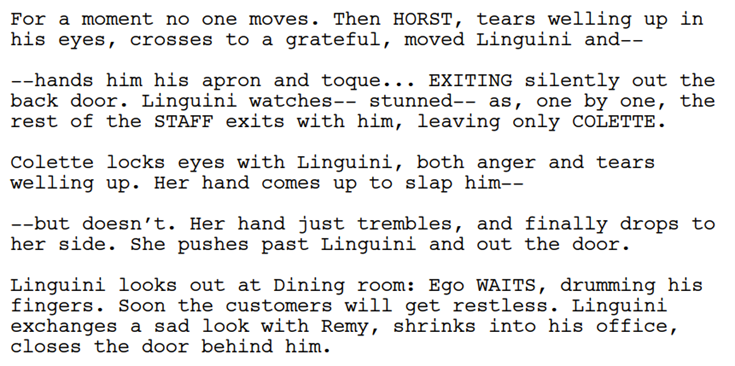
This plausible plot development marks the lowest point in the protagonists’ quest, the moment of greatest suffering (plot part four).
From this point on, thanks to Remy’s ratatouille recipe, the two worlds come together, and differences no longer stand in the way.
The narrating agent has “steered” their plot towards an optimistic resolution by replacing the believable with fantasy (“merveilleux”) https://en.wikipedia.org/wiki/: Paris becomes a world in which friendship and love triumph and rats cook.
In this film, real and supernatural worlds coexist, but the realism and plausibility factors can be applied to any type of world.
