
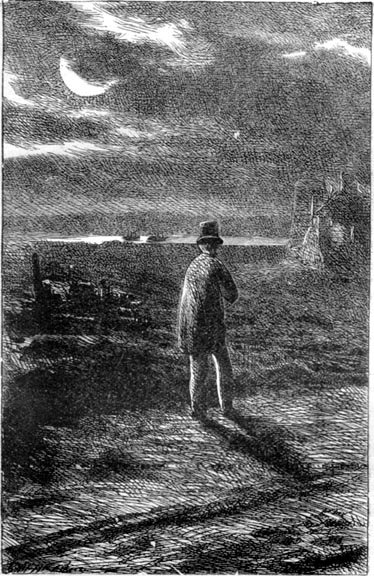
Great Expectations, Charles Dickens, 1860. Chapter 3.
Emotions can filter a viewpoint and cause someone to see only that which confirms their state of mind. If that person is a narrating agent, the retention factor is applied to their narrative/description.
The narrating agent selects what in the setting best expresses their feelings. Retention comes into play as well as a natural propensity of the narrative to personification and other pathetic fallacy (the alteration of an individual’s perceptions when beset by strong emotion).
While visiting his village cemetery to pay his respects to his parents’ grave, the young orphan Pip encounters an escaped convict who forces him to steal tools and food for him. The next morning, the boy joins the convict, but he does not cope well with his guilty conscience (an intrapersonal obstacle).
It was a rimy morning, and very damp. I had seen the damp lying on the outside of my little window, as if some goblin had been crying there all night, and using the window for a pocket-handkerchief.
The narrating agent selects what in the setting best expresses their feelings. Retention comes into play as well as a natural propensity of the narrative to personification and other pathetic fallacy (the alteration of an individual’s perceptions when beset by strong emotion).
While visiting his village cemetery to pay his respects to his parents’ grave, the young orphan Pip encounters an escaped convict who forces him to steal tools and food for him. The next morning, the boy joins the convict, but he does not cope well with his guilty conscience (an intrapersonal obstacle).
Now, I saw the damp lying on the bare hedges and spare grass, like a coarser sort of spiders’ webs; hanging itself from twig to twig and blade to blade. On every rail and gate, wet lay clammy; and the marsh-mist was so thick, that the wooden finger on the post directing people to our village – a direction which they never accepted, for they never came there – was invisible to me
until I was quite close under it. Then, as I looked up at it, while it dripped, it seemed to my oppressed conscience like a phantom devoting me to the Hulks.
Pip describes only what serves to represent his feelings. This limited point of view is meant to make us share a sense of entrapment (alienation is one of the themes of the novel). Pip feels caught in a huge spider’s web, suffocated by a thick fog that prevents him from moving freely. The sign points not only to his village, but also to the Pontoon Boats, prison ships that anchor offshore.
The mist was heavier yet when I got out upon the marshes, so that instead of my running at everything, everything seemed to run at me. This was very disagreeable to a guilty mind. The gates and dykes and banks came bursting at me through the mist, as if they cried as plainly as could be, ‘A boy with Somebody-else’s pork pie! Stop him!’
The selective point of view of the narrating-describing agent transforms the environment into a phantasmagorical and paranoid vision, a metaphor of his inner world.
