
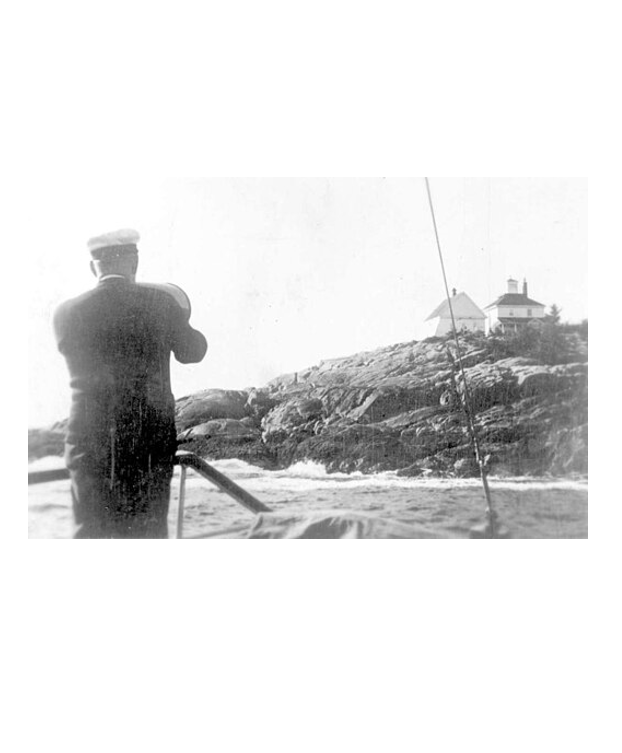
To the Lighthouse, Virginia Woolf, 1927
Who else but the “implicit author” can be behind the agent anonymously producing a narrative?
The opening of Virginia Woolf’s modernist novel gives first indications of the narrative choices of the “implicit author” in terms of point of view.
“Yes, of course, if it’s fine tomorrow,” said Mrs. Ramsay. “But you’ll have to be up with the lark,” she added.
The narrative is in the third person; the narrating agent does not include a description of themselves in their narration, since they are apparently not part of the plot (extradiegetic point of view).
To her son these words conveyed an extraordinary joy…
They not only report the words and actions of the characters, but also describe the emotions they feel and especially their thoughts (internal focalization).
When both tools are used (extradiegetic view point + internal focalization), which is common in literary narrative works, the receiving agent usually assumes that:
– The narrating agent is the “implicit author”.
– The thoughts and emotions of the characters that are described are really the thoughts and emotions of the characters.
Nevertheless the “implicit author” is free to decide otherwise and to exploit all the possibilities:
– The extradiegetic narrating agent can be anyone, including someone whose identity is unknown.
– The description of the characters’ thoughts may or may not be intentionally biased, inaccurate or incomplete (retention), and thus constitute one facet of the narrating agent’s interpretation of the plot.
– Ambiguity in both cases is perfectly acceptable. Particularly when a discourse can be either a commentary by the narrating agent or a description of the characters’ opinions and thoughts. For example:
Apart from the habit of exaggeration which they had from her, and from the implication (which was true) that she asked too many people to stay, and had to lodge some in the town, she could not bear incivility to her guests…
The most dramatic stylistic features of Woolf’s novel are the large number of “targets” of internal focalization (the narrating agent enters the thoughts of almost every character in the plot) and the unexpected changes of point of view, sometimes within the same sentence.
These “jumps” from one thought to another seem to make us think about the relationships of unexpressed feelings within a group of characters constrained by the social conventions of their time and their various psychic complexes. This is the usual analysis that exegetes make of Virginia Woolf’s work.
We propose here another form of cohesion, centered on the proposition that the narrating agent is in fact a character in the plot, who has decided to narrate it without revealing their identity.
The narrating agent would thus be in cohesion by selection with the world of the plot.
Our hypothesis is that these glances are those of Lily Briscoe, the painter of the group.
The young woman goes through a complete transformative experience, while Mrs. Ramsey is a temporary subject of observation (she dies between the first and second parts of the book).
Lily, in her thirties, is a complex young woman, whom the Ramseys have invited in the hope of finding her a husband. She sets up her easel and observes the subjects of her painting (Mrs. Ramsey and her son) and everyone else in the household. She is thus a privileged witness (her role as a painter legitimizes her gaze, we easily forget her discreet presence) of the tensions that are exerted around her, notably in the Ramsey couple, a model for her own reflections on the questions, very important to her, of marriage and the role of women in society, and also that of her relations with men. Thus Lily wonders whether she should emulate Mrs. Ramsey (become the ideal wife who suffers in silence), have an affair with Mr. Ramsey (the unscrupulous “free” woman), or free herself from all desire by marrying, as Mrs. Ramsey hopes, her faithful friend, William Bankes, the sweet and harmless sixty-something professor.
In the end, Lily manages to complete her painting despite the many doubts that beset her throughout the first part.
Lily, a diegetic character, could be the anonymous narrator of this narrative. She would use the “she” to talk about herself (her character in the plot), as if this person were no longer the one narrating this plot, and the thoughts of the other characters, a form of interpretation (what she thinks they think).
This narrative could thus be the result of a personal point of view, biased by Lily’s own situation (she lives with her parents), her beliefs (her feminism in gestation), her complexes (her insecurity is triggered by another guest who declares that women cannot be good painters or writers).
It is this “subjectivity” that builds the cohesion of the style (the multiple points of view) and the content of the reported thoughts (expressing mostly frustrations, unfulfilled desires…)
Such was the complexity of things. For what happened to her, especially staying with the Ramsays, was to be made to feel violently two opposite things at the same time; that’s what you feel, was one; that’s what I feel, was the other, and then they fought together in her mind, as now.
To explore the consciousness of her characters, Woolf’s narrating agent also uses a stylistic device called free indirect speech. Their thoughts, reactions, and voices are mixed with the narrating agent’s comments to evoke their most immediate responses to everyday experiences: this weaving of voices and points of view makes the narrative difficult to attribute to anyone as we saw in the previous excerpt. The “implicit author” uses this style expertly: we move from one character to another, often without comment from the narrating agent. The passages in free indirect style have the following characteristics: the verb tenses are mixed, the past perfect and conditional are used to remember and anticipate, the adverbs are anchored in the present (now) while the narrative is in the past. This hybrid style is difficult to translate because the translators’ choices can change the voices of the text and make it clearer or more homogeneous.
This narrative gives the impression of being blurred and distorted, like what Virginia Woolf called: “life as it is when you don’t take part in it”, an impression that seems to fit Lily’s character perfectly.
