
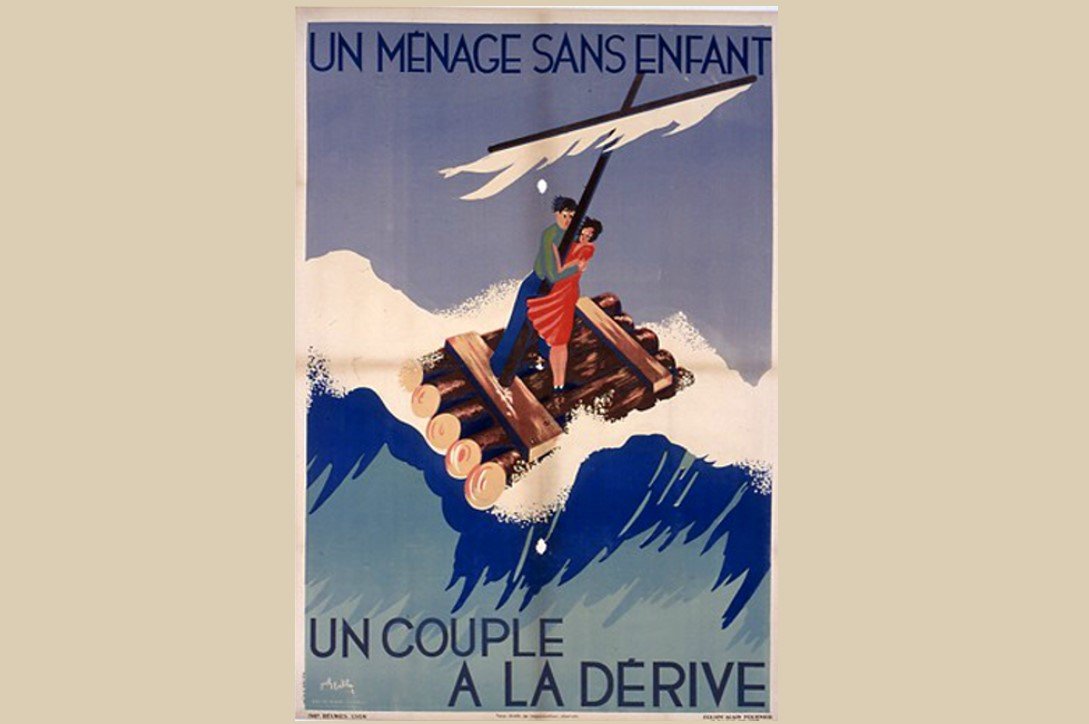
“A childless household is a couple adrift.”
Propaganda poster of the Vichy regime by a collective of poster artists from Lyon 1940-1944.
Arousing the emotion of the receiving agent by applying the cohesion factor to a propagandist argument.
The Vichy thesis is that a family represents the enviable ideal. By comparing it to its opposite, a childless couple in a bad situation, the narrating agent hopes to elicit an emotional response to convince the receiving agent.
The “plot” is about a young couple who are unlucky/unwilling to become parents. In a world where the autocrat (Pétain) firmly believes that the rights of the family take precedence over those of the individual, the young couple’s lives are brought into cohesion with an unfavorable and visually spectacular context: a raging sea.
The validity of this view is claimed by presenting what would happen, supposedly, if the rights of the individual took precedence over the rights of the family: the childless couple is compared by analogy to shipwrecked people (the still image shows us the “aftermath” of the event: the couple has taken refuge on a raft).
The propaganda is based on a “logic of feelings”. Its images mark, seduce, interfere in the unconscious of the recipient. The catchy, reductive, fallacious title seeks to take control of its audience by panicking it.
