
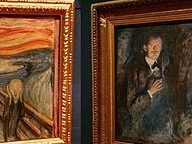
The Scream, Edvard Munch, 1893.
Edvard Munch recalls a personal experience to convey a powerful and devastating emotion. This skill has given this painting its iconic image status.
In ancient Greece, an “iconic statue” was an exact and faithful representation of a victorious athlete. The emotion depicted moves us by its accuracy and convinces us that its author could have felt it himself.
The words of Munch, who struggled all his life with symptoms of a hereditary mental illness, confirm our impression and shed light on the circumstances surrounding the depicted scene.
One evening I was walking along a path, the city on one side and the fjord below. I felt tired and sick. I stopped and looked towards the fjord – the sun was setting, and the clouds were turning blood red.*
First, the subject is confronted with an unpredictable natural phenomenon, this is the event :
...there was blood and tongues of fire above the blue-black of the fjord and the city…
But the painting represents the moment that follows the initial surprise, the horror and anguish felt by the protagonist.
– my friends were walking, and I stood there trembling with anxiety – and I felt an infinite scream pass through nature. It seemed to me that I heard the cry. I painted that picture, painted the clouds as real blood. The colour was screaming. It became The Scream.*
This reaction is not a concrete, physical consequence of the event (as in ‘it’s raining, I’m wet’) but of the protagonist’s interpretation of it, the effect it has on his or her psychological state. This image represents a moment of an intrapersonal event.
How does Munch manage to make us feel his distress in such a penetrating way?
He has an intimate knowledge of what he is depicting.
What proof do we have of this skill?
He shows us what only someone who has been there has seen, and he understands that an emotion is not limited to its physical expression:

… but also through the subjective vision it creates in the one who feels it.
The sky is as red as blood.
The black hole of the fjord is bottomless.
Nature “screams” so loudly that the protagonist has to cover his ears.
The body liquefies.

Friends look in his direction and probably judge him.
The perspective of the railing crushes him.
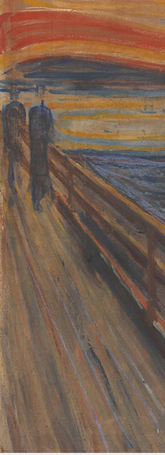
It is Munch’s sensitivity (his ‘skill’) that makes him see all this.
His singular vision convinces us of the emotional realism of the scene.
* Stanska, Zuzanna (12 December 2016). “The Mysterious Road From Edvard Munch’s The Scream”. Daily Art Magazine. Retrieved 23 October 2019.
