
Madame Bovary, Gustave Flaubert, 1857, transl. by Eleanor Marx-Aveling
The plausibility of a world depends, among other things, on the knowledge and skill competence of the narrating agent. How, in 1857, did Flaubert, a young author just starting out, manage to convince his readership of his competence?
A world is “represented” through the description of its specific features, but also of the actions and behaviors of the characters who inhabit it.
The narrating agent’s comments and argumentative discourse contribute to enrich our perception of the geographical and temporal space of this entity, as well as the inner world of its characters.
For the French realist movement of the 19th century, description is the sure value of literary expression. In his first novel, Flaubert makes great use of it to establish his reputation, gain the confidence of the public and the esteem of his peers.
M. Flaubert […] is an incessant and tireless narrator, he is an analyst who never gets confused; he is a describer of the most minute subtlety.
(Jules Barbey D’Aurevilly, [in] Le Pays, 1857)
Son of a provincial surgeon, the young Flaubert let himself be distracted for a long time by affairs of the heart and his passion for the Orient, before starting to write his first novel. His maniacal perfectionism slowed down his task considerably. It is only after five long years of hard work, at the age of thirty-five, that he publishes Madame Bovary.
It is an immediate success, a moral scandal which earns him a summons to court, but it is also a pebble thrown in the pond of the dominant Romanticism.
The heroine’s death by arsenic poisoning and its morbid details is the description most often cited by literary exegetes. But this scene is at the end of the book. At the time of the book’s publication, it only confirms the opinion of the readers about the author’s abilities. What about at the beginning of the narrative (the incipit of the book), when the fate of the reading hangs on the first impressions of the readers who cannot rely on the reputation of the author?
Does the description of the first world of the plot manage to make it credible and to ensure the adhesion of the readership for the duration of the narrative?
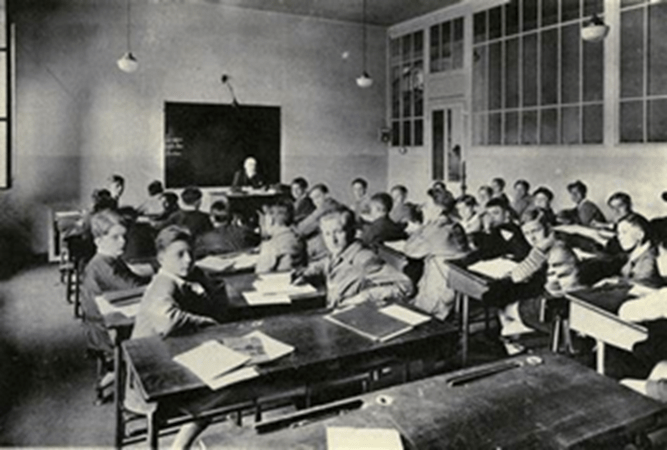
We were in class when the head-master came in, followed by a “new fellow,” not wearing the school uniform, and a school servant carrying a large desk.
The novel begins in medias res, the narrating agent projects us from the start into the heart of the action (this was rather unusual at the time).
Words are in brackets to indicate language specific to school children.
Those who had been asleep woke up, and every one rose as if just surprised at his work.
The Study: A space that is both physical and temporal. A character begins the description of the first world of the plot.
The head-master made a sign to us to sit down. Then, turning to the class-master, he said to him in a low voice—
“Monsieur Roger, here is a pupil whom I recommend to your care; he’ll be in the second. If his work and conduct are satisfactory, he will go into one of the upper classes, as becomes his age.”
This peculiar and somewhat enigmatic protocol for us (but none of the characters find it incongruous), helps lend credence to the narrating agent’s knowledge.
The “new fellow,” standing in the corner behind the door so that he could hardly be seen…
The beginning of the first “pure” description.
… was a country lad of about fifteen, and taller than any of us. His hair was cut square on his forehead like a village chorister’s; he looked reliable, but very ill at ease.
Our gaze is directed by the narrating agent, from head to toe (cohesion factor/selection). The observer adopts a somewhat condescending tone (world of the narrating agent).
Although he was not broad-shouldered, his short school jacket of green cloth with black buttons must have been tight about the arm-holes, and showed at the opening of the cuffs red wrists accustomed to being bare. His legs, in blue stockings, looked out from beneath yellow trousers, drawn tight by braces, He wore stout, ill-cleaned, hob-nailed boots.
He knows that “country boys” wear jackets made of cloth (not wool, velvet, or cashmere.)
His eyes are able to slip through the cracks and pick up telling, circumstantial clues (outdoor living = red wrists).
We began repeating the lesson. He listened with all his ears, as attentive as if at a sermon, not daring even to cross his legs or lean on his elbow; and when at two o’clock the bell rang, the master was obliged to tell him to fall into line with the rest of us.
This passage describes the routine of the first world of the plot. It shows the shift in the new and demonstrates the narrating agent’s knowledge of this environment.
When we came back to work, we were in the habit of throwing our caps on the ground so as to have our hands more free; we used from the door to toss them under the form, so that they hit against the wall and made a lot of dust: it was “the thing.”
Another word from the vernacular vocabulary.
But, whether he had not noticed the trick, or did not dare to attempt it, the “new fellow,” was still holding his cap on his knees even after prayers were over. It was one of those head-gears of composite order,
Second “pure” description: the new boy’s hat.
… in which we can find traces of the bearskin, shako, billycock hat, sealskin cap, and cotton night-cap;
Specialized terms for an accumulation of comparisons.
... one of those poor things, in fine, whose dumb ugliness has depths of expression, like an imbecile’s face.
The observer makes a judgment of a person on the basis of a piece of clothing that is shocking to him.
Oval, stiffened with whalebone, it began with three round knobs; then came in succession lozenges of velvet and rabbit-skin separated by a red band; after that a sort of bag that ended in a cardboard polygon covered with complicated braiding, from which hung, at the end of a long thin cord, small twisted gold threads in the manner of a tassel.
He now feels that the comparative description at the beginning is not enough and needs to give even more details about the object…
The cap was new; its peak shone.
… to end with a final sarcastic outburst: the “poor thing” is getting attention!
“Rise,” said the master.
He stood up; his cap fell. The whole class began to laugh. He stooped to pick it up. A neighbor knocked it down again with his elbow; he picked it up once more.
“Get rid of your helmet,” said the master, who was a bit of a wag.
There was a burst of laughter from the boys, which so thoroughly put the poor lad out of countenance that he did not know whether to keep his cap in his hand, leave it on the ground, or put it on his head. He sat down again and placed it on his knee.
The cap is “set up” to reveal the social “incompetence” of the novice and the cruelty of the group.
The descriptive agent needs no more than fifty lines of text to specify their choices and demonstrate their skills in descriptive realism of a specific world.
The competence of the descriptive/narrating agent are exercised on two levels: that of the material (the constituents of the world) and that of its representation (strategies for putting it into narrative/descriptive form).
1. The descriptive agent knows what the different worlds of the plot are made of.
Their skills are the result of research (or of substantial personal experience). They are manifested by the use of specific, even technical, terms and explicit images.
Flaubert scoured encyclopedias, visited many places, collected notes and drew sketches.
2. The descriptive agent understands how these worlds work.
A description is not just about appearances, it is also about processes. In the third paragraph, by describing the routine of a day, i.e., the cause/effect logic that underlies this school world, the descriptive agent helps make it believable to us.
As the map of Yonville, the Bovaries’ place of residence, illustrates, Flaubert bases the reality of his fictional worlds on a rigorous organization of space and time.
3. The narrating agent uses the situations given by a world to build characters.
The description of the world of the school is not a simple enumeration or an illustrative representation of reality (the fear of the realists of the time of being only “Daguerreotypers” https://en.wikipedia.org/wiki/Daguerreotype ), thanks to his mastery of the setting in narration, the narrating agent manages to make it say more than it shows.
The description of the new boy doesn’t stop at constructing the image of a country boy parachuted into a social milieu that is not his own, it also conveys impressions from his inner world (the embarrassment, the inappropriate gear, the pants that are “too tight”) which will evolve into the salient character traits of the adult Monsieur Bovary: his social anxieties, his physical awkwardness, his repressed emotions.
4. The narrating agent makes distinctive choices regarding representation.
In his correspondence, Flaubert declares that he wants to make it real, to paint reality and feelings without embellishment, without “elevation of soul”, without tremolo in the voice, without any of the sentimentalist excesses of Romanticism.
The “implied author” does not hesitate to begin his narrative in the down-to-earth world of schoolchildren, a “world under a world” (said the Goncourt brothers) usually snubbed by the belles-lettres of the time, who shunned the everyday and the prosaic on principle.
With this shocking, even “militant” beginning, the personality of the “implicit author” bursts forth from the outset and his convictions favorably prepare the ground for the narrative pact.
5. The narrating / descriptive agent brings their personal touch to the world they describe.
Thus, the description of a world is not only a representation of the features of an animate or inanimate object, or of the symbolic relationship they have with the inner world of this object (the strong and studded shoes for the involuntary anti-conformism of the new boy), it is also the potential seat of the personal expression of the narrating agent, which is never so well conveyed as through his explicit or implicit comments.
The descriptive agent first makes us understand that he finds the cap ridiculous by comparing it to the other boys’. Everything could stop at the word “imbecile”, but the description continues to become more and more precise, geometric, technical, giving the impression of being in freewheel until a final climax in the form of an ironic observation, the observation that someone could have had the idea of buying such an object for this precise occasion (“it was new”) and his insistence on attracting attention (“the visor was shiny”)
This crescendo, almost musical, reveals the “implicit author’s touch”. By contradicting his attempts to take a “scientific” look at reality with this lyrical flight, Flaubert reveals a relationship to reality that is much more complex and ambivalent than was initially suggested.
Realism in its pure state does not exist. An intention always ends up fading behind the energy of the vision.
