
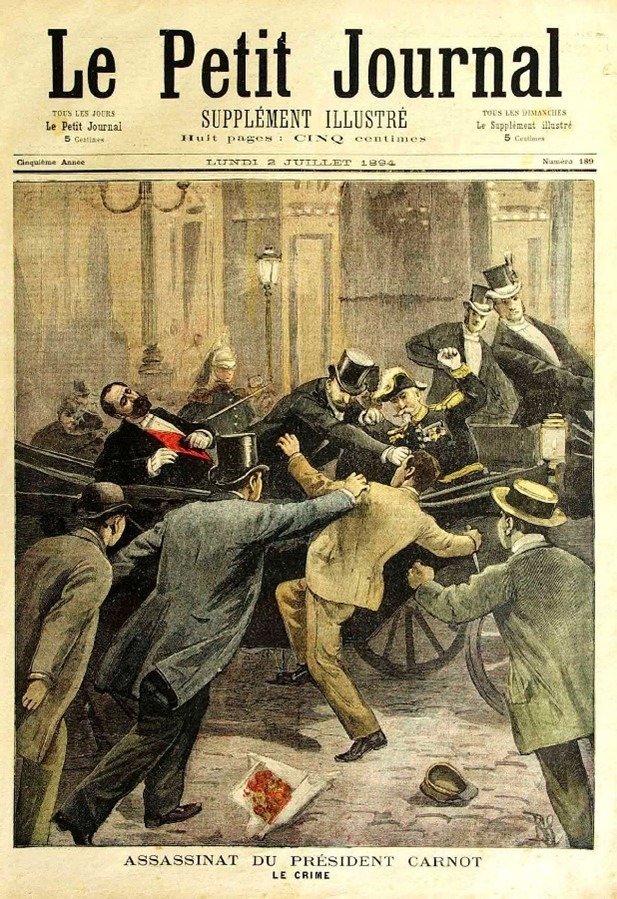
Assassination of President Carnot. Le Petit journal, supplement, 2 July 1894
The cohesion factor applied to the reaction that follows an event (= action to achieve an objective) can give a particular meaning to that event.
In Lyon in 1894, as the President of the Republic Sadi Carnot leaves a banquet to go to the theatre (objective), the Italian anarchist Sante Geronimo Caserio stabs him to death (obstacle). Carnot is the first president to die in office, the first to be assassinated.
The presence of the assassin is not a coincidence, but the president (or his security service) has put himself in a situation favourable to the designs of a fanatic antagonist: open-air and slow-moving carriage in narrow streets.
Sometimes, behind an interpersonal event there may be a functional event. It is possible that the narrative will provide a perspective on this, or try to tip the balance one way or the other…
The drawing published in the weekly supplement of Le Petit Journal does not represent the core of the main event, namely the assault itself, but the action that followed: three officials physically attacking the assassin.
This image conveys two messages: 1. President Carnot was assassinated. 2. The people around him showed great courage and determination (even the general in his parade dress threw a punch…)
This action is linked to the interpersonal event through the application of the cohesion/inevitability factor. When the president is attacked, those around him can only react heroically… this image ‘tells’ us.
Other interpersonal events captured at the moment that best fits the meaning their narrating agents want to give to them:
At the beginning of the interpersonal event: Casca pulls out his dagger as Cimber pulls Caesar’s tunic to signal the conspirators to take action. The emperor faces unanimity.

At the heart of the interpersonal event: the precise moment when Franz Ferdinand is shot. Only the Duchess Sophie has time to react: she embraces her husband at the very moment when Princip shoots him. The chronological continuity is changed to accentuate the impression of inevitability.

The immediate aftermath. An intrapersonal event (Jackie Kennedy’s panic) generated by the interpersonal event (the assassination of her husband). The causality accentuates the realism of the situation. Unlike in the previous example, the photographic narrating agent cannot alter the actions of the characters and their timeline.

