
Narrative still images (narrative art)
A still image, or a three-dimensional art object (sculpture, scenographic arts, installation, etc.) can be partially narrative.
More often than not it shows only some of the elements that make up an event (protagonist, objective, action, obstacle, surprise, insight).
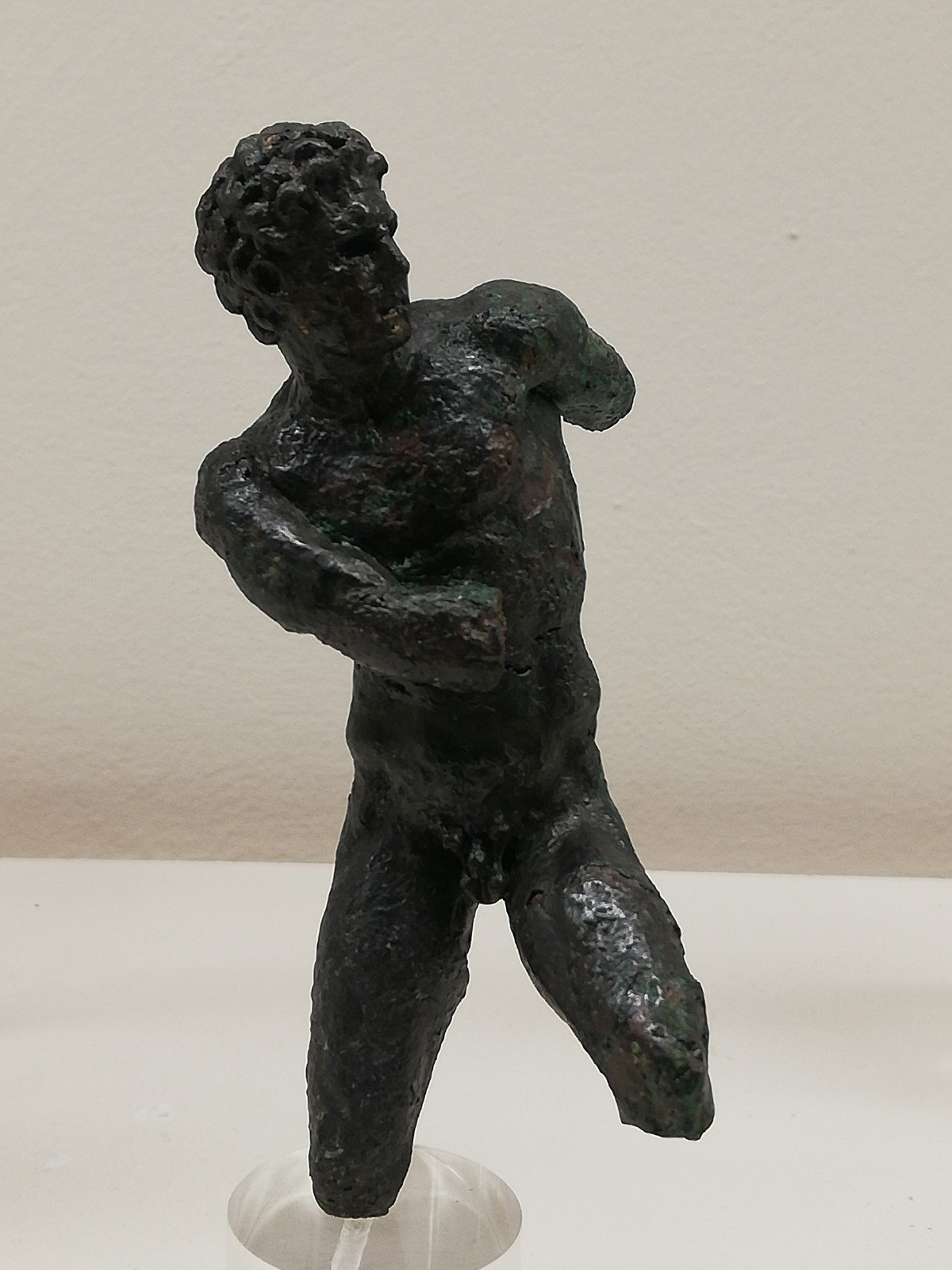
Narrative art example: Miniature votive, Lugdunum Musée et théâtre romain, Lyon
photo P Longchamp
In narrative art, this restriction is due to the temporal structure of the event. To understand the cause of a surprise (which drives the narrative tension), we need to know what objective was being pursued before the obstacle appeared.

To explore further the concept of
event
Those who look at a still picture are always co-creators of its narrative tension.

Mona Lisa by Leornado Da Vinci – Leonardo da Vinci
Public domain, via Wikimedia Commons narrative art
Sometimes, the narrative nature of an image is not visible, as its existence can neither be affirmed nor ruled out with certainty.
Leonardo da Vinci’s most famous painting seems to be descriptive (it shows us the noble Lisa del Giocondo as the painter saw her), although we cannot overlook the possibility that an intrapersonal event is taking place before our very eyes (the reason for the famous smile?).
To explore further the concept of
intrapersonal event
Examples of narrative elements in narrative art images:
1. The protagonists are confronted with a gigantic obstacle.
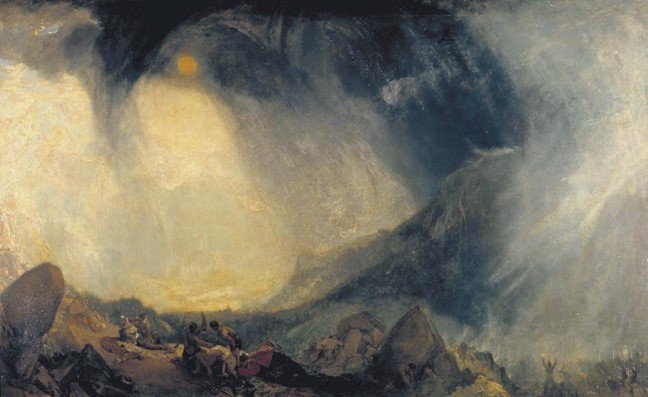
Narrative art example: Snow Storm: Hannibal and his Army Crossing the Alps, J. M. W. Turner, 1812,
Tate Britain, Public domain, via Wikimedia Commons
To explore further the concept of
contingent event
2. The surprise right after being confronted with an obstacle.

Narrative art example: Long khanh fallen by pfc. L. Paul Epley., Public domain, via Wikimedia Commons
To explore further the concept of
emotion
3. Protagonists, action, obstacle, surprise. The objective is not represented. The viewer has to have historical or biblical knowledge in order to understand the situation.
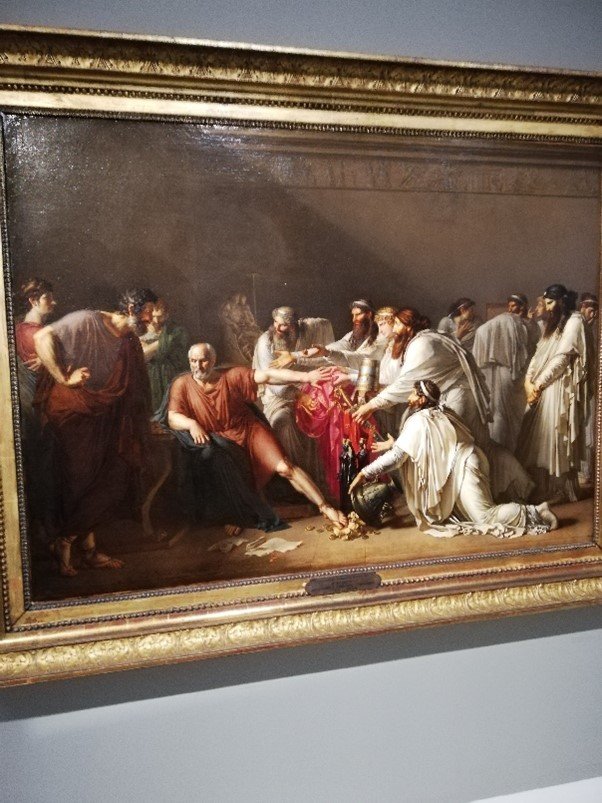
Narrative art example:Hippocrates refusing Artaxerxes’ gifts, Anne-Louis Girodet-Trioson,
(1792), photo P. Longchamp

Narrative art example: Detail from an Apulian red-figured volute-krater, ca. 410–400 BC. From Ruvo.
British Museum, Public domain, via Wikimedia Commons
To explore further the concept of
cognitive experience
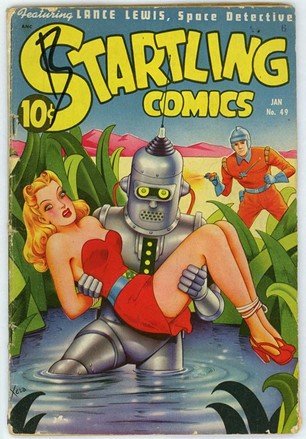
4. Representation of an event that is a reaction to a previous event: protagonists, obstacle (the robot kidnaps the young woman), new objective and action (to neutralize the robot)
To explore further the concept of
interpersonal event
5. A historiated capital showing the consequences of an event (an argument), probably a physical fight (new objectives and obstacles)
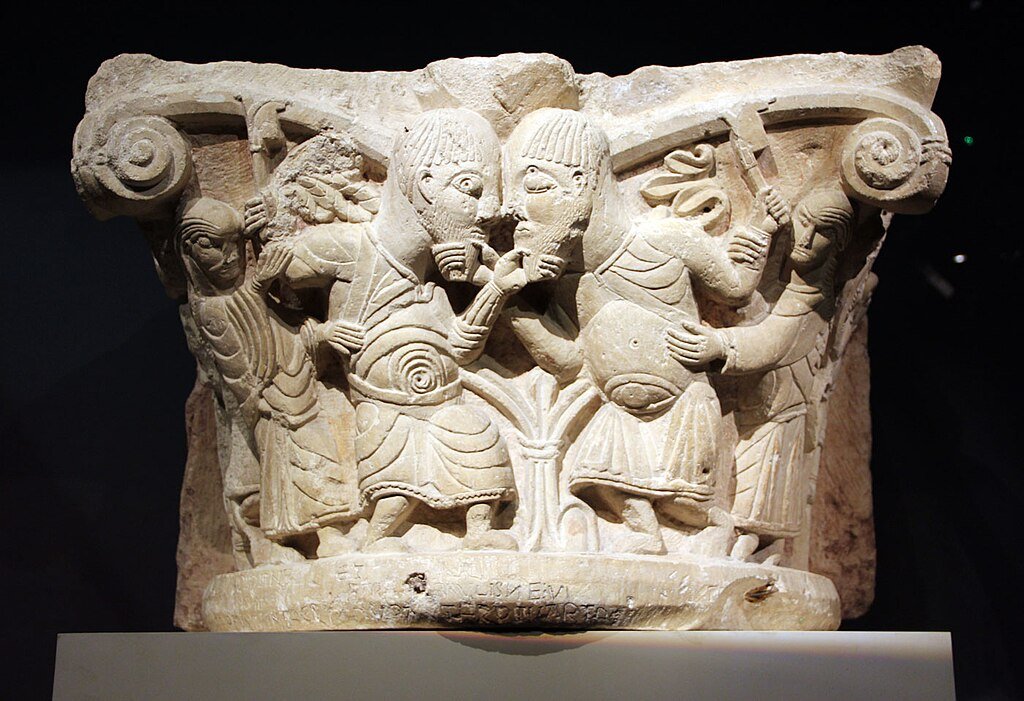
Narrative art example: Chapiteau de la Dispute. Poitiers. Musée Sainte-Croix. XIe siècle
Public domain, via Wikimedia Commons
Find out
how to create an event
6. Protagonists and an objective known only to those viewers who are informed of the historical event to which the work refers (the siege of Calais in 1347).
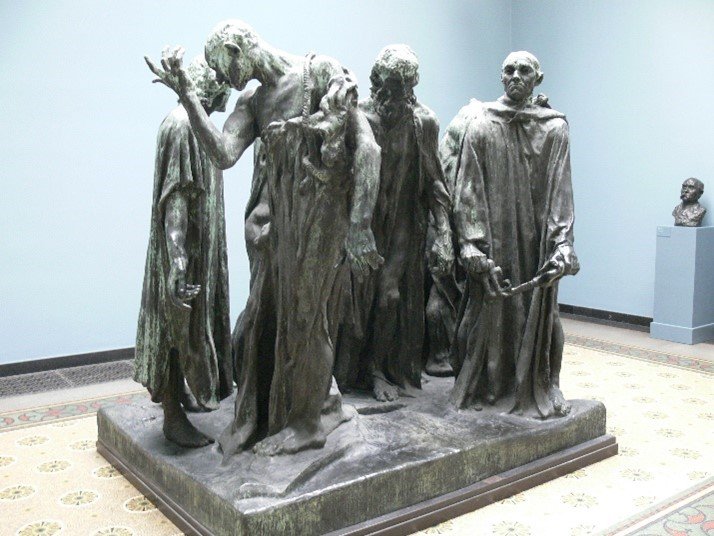
The Burghers of Calais, Rodin
Public domain, via Wikimedia Commons
To explore further the concept of
narrative pact
7. An image that does not, in principle, show an event, but rather the protagonists in a particular situation.
But if we look more closely, we can interpret certain visual cues as possible components of micro-events (objectives, obstacles, surprises).

Luncheon of the Boating Party, Pierre-Auguste Renoir
Public domain, via Wikimedia Commons
To explore further the concept of
retention
8. An image representing objectives and obstacles. The situation allows us to imagine the functional event that took place inside the room.
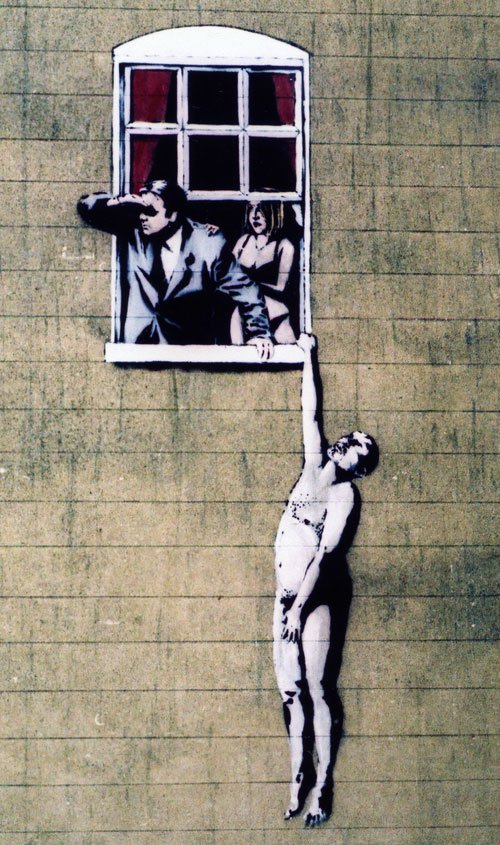
Banksy graffiti on the Bottom of Park Street Bristol
<http://creativecommons.org/licenses/by-sa/3.0/>, via Wikimedia Commons
To explore further the concept of
functional event
9. A narrative art special case: an individual still image that represents all the elements of an event.
The same protagonist (the apostle Peter) appears three times in the same image. In a comic strip, this event would have required a sequence of at least four adjacent drawn images (“panels”).

Tribute Money, Masaccio, circa 1426
Public domain, via Wikimedia Commons
24 After Jesus and his disciples arrived in Capernaum, the collectors of the two-drachma temple tax came to Peter and asked, “Doesn’t your teacher pay the temple tax?”
25 “Yes, he does,” he replied.
When Peter came into the house, Jesus was the first to speak. “What do you think, Simon?” he asked. “From whom do the kings of the earth collect duty and taxes—from their own children or from others?”
26 “From others,” Peter answered.
“Then the children are exempt,” Jesus said to him.
27 “But so that we may not cause offense, go to the lake and throw out your line. Take the first fish you catch; open its mouth and you will find a four-drachma coin. Take it and give it to them for my tax and yours.”
