
What (other) plot element(s) do you have at this stage? What are the constituants of a plot?
• A situation
A set of material, geographical, physical, and psychological factors that influence the behavior and state of mind of the protagonist at a particular time.
Situation
»
• The objective of a protagonist
Explicit or implicit, conscious or not.
Objective
»
• A protagonist proceeding in order to obtain a certain result.
An action is a strategy (physical movements and/or words) chosen by the protagonist to achieve an objective.
Action + Objective
»
• A situation and an objective
Within a situation (see above), a protagonist pursues a specific objective.
Situation + Objective
»
• A situation and an action
Situation + Action
»
• An obstacle or an action + an obstacle
An obstacle is a force that creates surprise (one that interrupts the pursuit of an objective), an adjuvant force (one that allows an objective to be reached unexpectedly, unpredictably, or sooner than expected), a complicating agent, a mystery.
An obstacle generates an event – the fundamental component of a plot – and its five most common effects: surprise, suspense, fear, insight, curiosity.
Action + Obstacle
»
• All the constituant elements of the main plot event: protagonist + objective + action + obstacle + surprise
Your event is at the center of the plot. It is known here as a plot knot (in Casablanca, the plot revolves around the unexpected arrival of Ilsa Lund and her husband (= the knot). For a still image, the scene depicted feels like it is part of a set of facts, a “story,” e.g., a war scene, an episode from the Bible, mythology, etc.)
A complete plot knot
»
More about event ↓
Example of an event
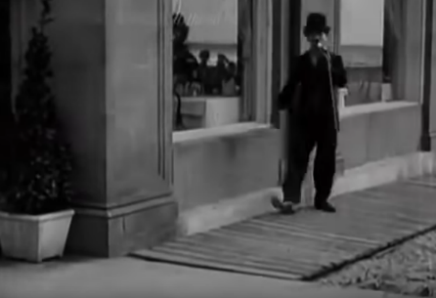
By the Sea, Charlie Chaplin, 1915
A situation, a protagonist, and an objective
In a specific environment, the protagonist pursues an explicit or an implicit objective.
Charlie wanders in town, looking for…? Going to…?
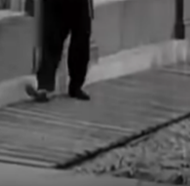
One/several action(s)…
… supposed to make the protagonist reach their objective(s).
He walks…

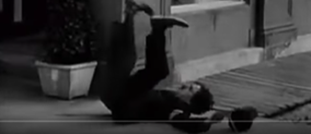
An opposing /adjuvant /burdening element.
… that prevents him from getting what he wants or that gives him what he didn’t dare to hope for so soon.
The antagonistic nature of the disruptive element triggers a “tension”: Everything was going well (routine, plans, predictability, known factors, inertia, etc.) until something happens (alteration, unpredictability, the unknown, change, the exception, chaos, etc.).
A banana peel! A tumble!
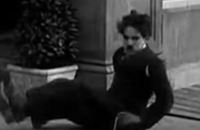
Emotional responses
First there is a sudden change in the emotional state of the protagonist, and sometimes of the receiving agent (reader/spectator/listener).
The protagonist went from casualness to dismay.
Then (or simultaneously) comes surprise. It is created by the difference between what the protagonist had hoped for and what has just happened.
The possible consequences of the disturbing element generate suspense. “What will happen next?” “How will the protagonist react?
It is this suspense that “moves” a plot forward by creating curiosity (a motivation to wait for the reveal, a desire to predict the answers to these questions).
Did he get hurt? Will he get up again?…
To continue, answer question above ↑
Examples of plot elements
Situations
• The Handmaid’s Tale, Margaret Atwood, 1985. In a dystopian and patriarchal society, Defred, one of the few women who can still conceive, is condemned to role of a genitor. She has only one function: to procreate
• Tintin in Tibet, Hergé, 1960. Tintin and Captain Haddock are on vacation in a resort in the French Alps.
• L’arroseur arrosé, Louis Lumière, 1895. A gardener takes care of his vegetables.

Lugdunum Musée et Théâtre romain
Objectives
• In The Handmaid’s Tale, Offred (real name June) wants to find her husband and daughter who have fled to Canada…
• Tintin in Tibet. After parting with Captain Haddock for a day trip to the mountains, Tintin comes back to the hotel and wants to have the company of his friend.
• L’arroseur arrosé, Louis Lumière, 1895. The gardener wants to water the plants in his garden.

Actions or action + objective
• The Handmaid’s Tale. A young woman joins a secret network in the hope that one day she will be reunited with her family.
• Tintin in Tibet. Tintin plays chess with Captain Haddock despite his physical fatigue.
• L’arroseur arrosé. The gardener uses a hose to give water to his plants.
Sometimes an action can be involuntary, a nervous reflex or a “Freudian slip” dictated by the character’s unconscious:
When they got up to go, the two nuns, I did something very stupid and embarrassing. I was smoking a cigarette, and when I stood up to say good-by to them by mistake I blew some smoke in their face. I didn’t mean to, but I did it.” The Catcher in the Rye, J.-D. Salinger, 1951, p 147


https://en.wikipedia.org/wiki/en:Rowland_Scherman

James Gillray, Public domain, via Wikimedia Commons

Lugdunum Musée et Théâtre romain
Situations + objective
• The Handmaid’s Tale. In a dystopian and patriarchal society, Defred, one of the few fertile women, whose official role is human reproduction, dreams of being able to join her husband and daughter who escaped to Canada.
• Tintin in Tibet. Tintin and Captain Haddock are vacationing in a resort in the French Alps. Tintin wants to keep Captain Haddock company, but the retired seaman does not care for mountain excursions…
• L’arroseur arrosé. The gardener notices that his vegetables need water, he wants to water them…

Wikimedia Commons

Lugdunum Musée et Théâtre romain
Situations + actions
• The Handmaid’s Tale. In a dystopian and patriarchal society, Defred/June, one of the few fertile women whose official role is human reproduction, joins a secret network…
• Tintin and Captain Haddock are vacationing in a resort in the French Alps. They play chess.
• L’arroseur arrosé. The gardener notices that his vegetables need water, and uses a hose to water them…

Wikimedia Commons

Wikimedia Commons
Obstacles
• The Handmaid’s Tale. In Gilead, the secret police known as the Eyes punish any act of rebellion. The Hunters hunt down those who try to leave the country…
• Tintin falls asleep while playing chess with Captain Haddock. He dreams that his friend Tchang has been the victim of a plane crash…
• L’arroseur arrosé. The water stops flowing from the gardener’s hose…
• The Catcher in the Rye, J.-D. Salinger, 1951. 17-year-old Holden Caulfield is… lost.

