
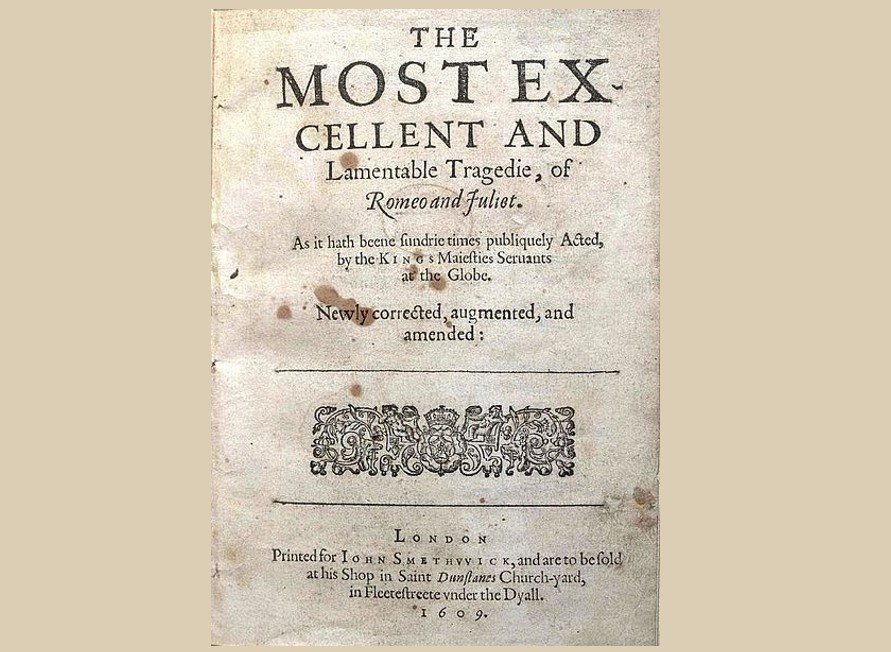
Romeo and Juliet, William Shakespeare, 1597
The narrating agent may want to openly recognize the limitations of their power.
Shakespeare chooses to adapt a plot known to all his contemporaries (the love affairs of young people thwarted by their families), and draws from a poem published a few years before his birth (Arthur Brooke’s The Tragical History of Romeus and Juliet (1562)) the main events of the plot of his tragedy.
Fratricidal struggles, family quarrels and lovers separated by the conflicts of their time are legion in ancient texts. Pyramus and Thisbe try to love each other in Ovid, Troilus and Criseyde are separated by the stakes of the Trojan war in Chaucer. Tragic lovers are found in medieval folk tales, sixteenth-century European poems, and even Brooks’ uplifting poem.
But Shakespeare’s intention is not to play on the heartstrings. He creates no suspense around this family conflict and reveals the plot in the first words spoken by the chorus:
Two households, both alike in dignity
(In fair Verona, where we lay our scene),
From ancient grudge break to new mutiny,
Where civil blood makes civil hands unclean.
What the “implicit author” is seeking to accomplish here (intentionality) is a means to gain our confidence and to arouse our interest (narrative pact).
We are warned that a familiar plot is going to be told to us (this can be reassuring) and that the interest of what is going to follow is not so much in the plot as in the way it is going to be told to us. The author is so confident of these skills that he can afford to reveal a major spring of his tragedy at the outset.
But this revelation is part of the conditioning to which the narrating agents (author + chorus) want to subject us at the beginning of the performance. The quarrel cannot be resolved, the lovers have already lost and are heading towards death. The narrating agents warn us that their intention is rather to be interested in the works of destiny.
From forth the fatal loins of these two foes
A pair of star-crossed lovers take their life;
Whose misadventured piteous overthrows
Doth with their death bury their parents’ strife.
The young lovers will suffer and die without being able to do much about it. Our attention is immediately directed to the “how” of fate, not the “why”, a vast subject that the narrating agents recognize as such.
The which, if you with patient ears attend,
What here shall miss, our toil shall strive to mend.
The imperfection of the narrative will be compensated for by the goodwill of the narrating agent. The receiving agent is now willing to give it a chance, despite (or because of) the predictability of the plot, but also the acknowledged limitations of the capacities of the narrating agents in the face of human folly.
